Circular Economy and Digital Platforms: New Models for Organizational Innovation
Abstract
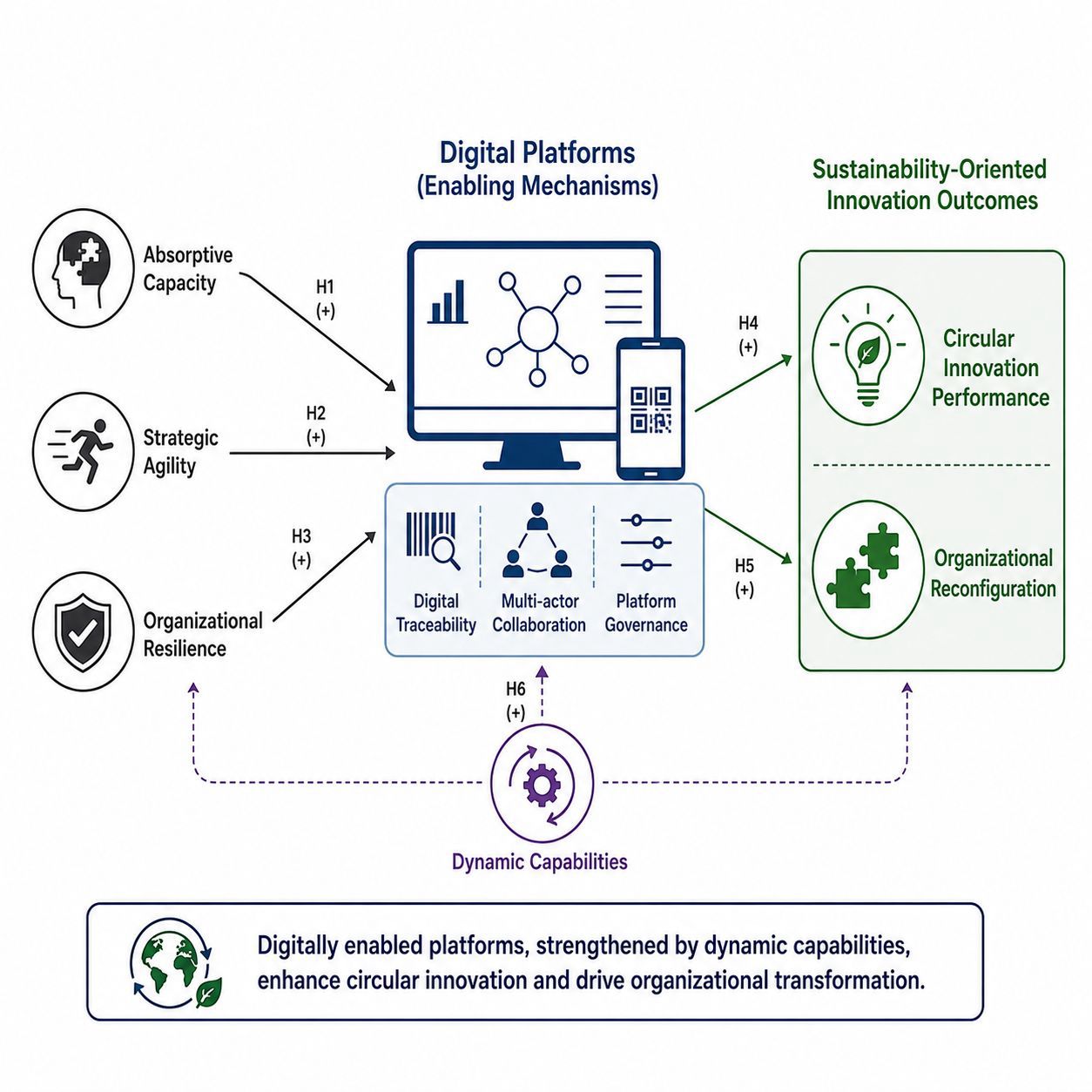
The convergence between digital platforms and circular economy practices is transforming organizational innovation and sustainability-oriented business models. This study analyzes how digitally enabled ecosystems contribute to circular innovation through dynamic capabilities such as absorptive capacity, strategic agility, and organizational resilience. Using a sequential explanatory mixed-methods design, the research combines quantitative analysis of 60 digital platforms with qualitative evidence from interviews and content analysis. The findings reveal that digital traceability, multi-actor collaboration, and adaptive organizational capabilities positively influence circular innovation performance and organizational reconfiguration. The study demonstrates that digital platforms operate not only as technological infrastructures, but also as organizational coordination mechanisms that support sustainability-oriented transformation. The research contributes to the literature by integrating circular economy, digital platforms, and dynamic capability theory into a unified framework explaining the emergence of new organizational innovation models.Downloads
References
Abbes, I. (2025). Strategic pathways for innovation and sustainability in digital transformation: Insights from leading global companies. Social Sciences and Humanities Open, 12, 101906.
Antikainen, M., Uusikylä, K., & Kivikytö-Reponen, P. (2018). Digitalisation as an enabler of circular economy. Procedia CIRP, 73, 45–49.
Bocken, N. M. P., de Pauw, I., Bakker, C., & van der Grinten, B. (2016). Product design and business model strategies for a circular economy. Journal of Industrial and Production Engineering, 33(5), 308–320.
Creswell, J. W., & Plano Clark, V. L. (2018). Designing and conducting mixed methods research (3rd ed.). Sage Publications.
Del Vecchio, P., Secundo, G., Ndou, V., & Passiante, G. (2021). Mobilizing intellectual capital to improve sustainability in smart cities: A meta-analytic review. Journal of Cleaner Production, 278, 123806. ttps://doi.org/10.1016/j.jclepro.2020.123806
Garrido-Moreno, A., Martín-Rojas, R., & García-Morales, V. J. (2024). The key role of innovation and organizational resilience in improving business performance: A mixed-methods approach. International Journal of Information Management, 77, 102777.
Geissdoerfer, M., Savaget, P., Bocken, N. M. P., & Hultink, E. J. (2017). The circular economy – A new sustainability paradigm? Journal of Cleaner Production, 143, 757–768.
Khan, M. T. I., Zhou, M., Khan, M. M. H., & Waqas, M. (2024). Digital technology adoption, innovation, and globalization for sustainable economic growth: Evidence from Asia-Pacific. Environmental Challenges, 9, 100876. https://doi.org/10.1016/j.envc.2024.100876
Kirchherr, J., Reike, D., & Hekkert, M. (2018). Conceptualizing the circular economy: An analysis of 114 definitions. Resources, Conservation and Recycling, 127, 221–232.
Köhler, A. R., Bakker, C., & Peck, D. (2022). Dynamic capabilities and open innovation for circular economy implementation. Business Strategy and the Environment, 31(6), 2678–2693.
Liu, Y., Lim, M. K., & Tan, K. H. (2021). Towards circular economy: The roles of digitalization and sustainability orientation. Resources, Conservation and Recycling, 168, 105267. https://doi.org/10.1016/j.resconrec.2021.105267
Maddah, N., & Heydari, B. (2024). Platform-driven collaboration patterns: Structural evolution over time and scale. IEEE Transactions on Computational Social Systems, 11(6), 7814–7829.
Mishra, A. R., Singh, R., & Lim, M. K. (2024). Overcoming barriers to digital technologies for sustainable food supply chains: A hybrid MCDM approach. Resources, Conservation and Recycling, 194, 106865. https://doi.org/10.1016/j.resconrec.2023.106865
Mohamed Hashim, M. A., Tlemsani, I., & El-Temtamy, O. (2024). The impact of platform business models on organizational performance in the era of Industry 5.0: A strategic agility and innovation approach. International Journal of Technology Management and Sustainable Development, 23(3), 299–321.
Nambisan, S., Lyytinen, K., Majchrzak, A., & Song, M. (2017). Digital innovation management: Reinventing innovation management research in a digital world. MIS Quarterly, 41(1), 223–238.
Prikshat, V., Okumus, F., & De Martino, M. (2025). Sustainable circular innovation ecosystem for hospitality and tourism. Tourism Review.
Sgarbossa, F., et al. (2024). Digital technologies in production systems for achieving sustainable development goals. Sustainable Production and Consumption.
Vigren, O., Kadefors, A., & Eriksson, K. (2022). Digitalization, innovation capabilities and absorptive capacity in the Swedish real estate ecosystem. Facilities, 40(15–16), 89–106.
Wang, S., Mao, J.-Y., & Wang, F. (2024). Generativity of enterprise IT infrastructure for digital innovation. Internet Research, 34(6), 1932–1962.
Wu, H., Li, S., Zhang, X., & Hou, W. (2025). Achieving sustainable innovation: A fit model of digital platforms and absorptive capacity. Sustainability, 17(19), 8611.
Wu, J., et al. (2024). Digital platforms and value creation in circular economy ecosystems. Journal of Cleaner Production.
Zhao, X., et al. (2024). Circular economy practices and sustainability performance: A systematic review. Sustainable Production and Consumption.
Zhou, Y., et al. (2024). Digital transformation and corporate sustainability: Conceptual inconsistencies and future research directions. Technological Forecasting and Social Change.
Published papers are the exclusive responsibility of their authors and do not necessary reflect the opinions of the editorial committee.
IJMSOR respects the moral rights of its authors, whom must cede the editorial committee the patrimonial rights of the published material. In turn, the authors inform that the current work is unpublished and has not been previously published.
This work is licensed under a Creative Commons Attribution-NonCommercial-NoDerivs 3.0 Unported License.