Digital Twin–Driven Optimization in Smart Manufacturing: A Simulation-Based and Data-Driven Approach for Industrial Systems
Abstract
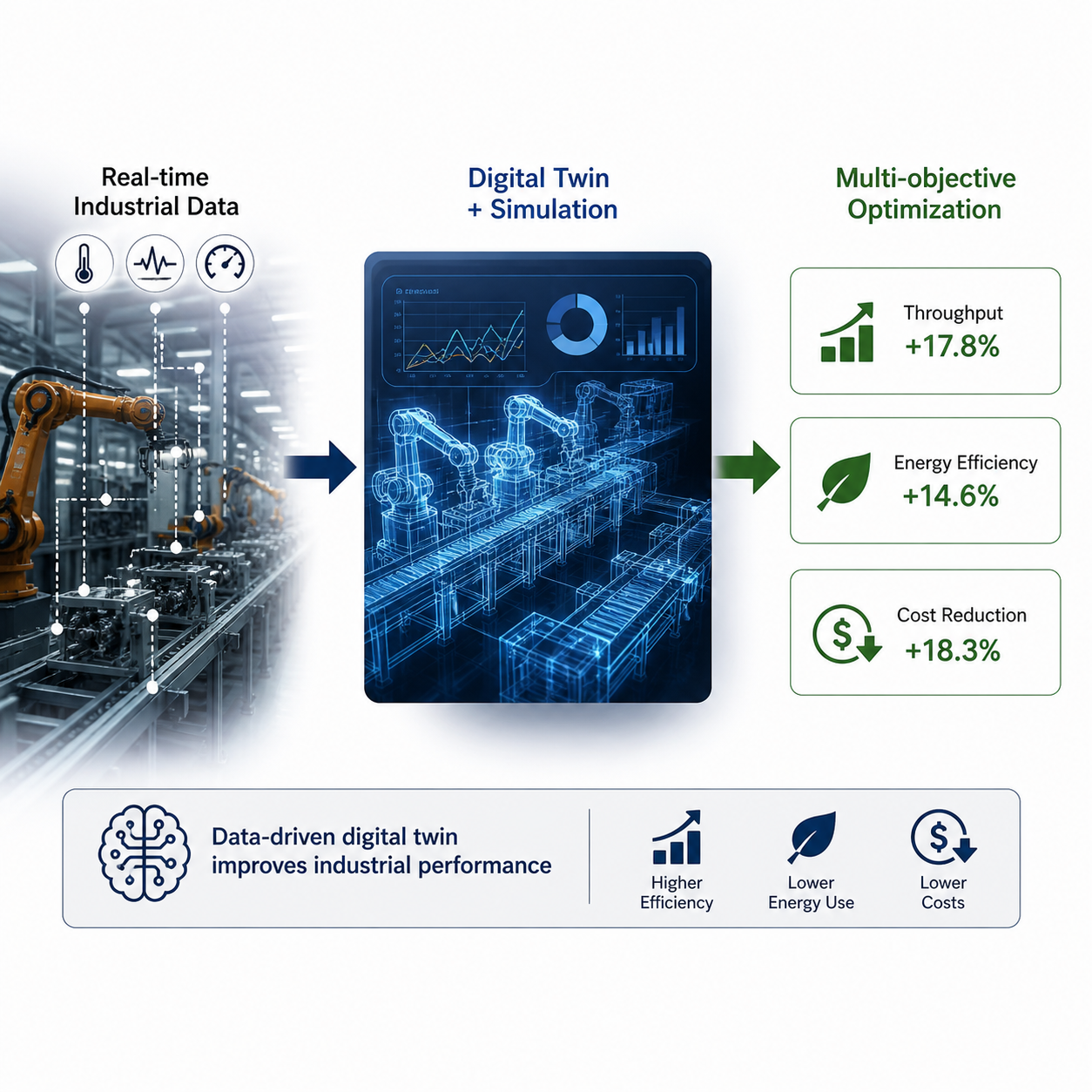
The advancement of Industry 4.0 has accelerated the adoption of digital twin technologies; however, existing research remains fragmented, lacking integrated frameworks that combine data-driven analytics, simulation, and optimization. This study develops and validates a hybrid model that integrates digital twin architectures with simulation-based modeling and multi-objective optimization to enhance industrial system performance. A synthetic dataset of 1,000 observations was generated to represent industrial IoT environments, incorporating production, energy, operational, and sensor variables. The model was implemented using AnyLogic, Python, and MATLAB, and evaluated across different digital twin maturity scenarios. Results show statistically significant improvements in throughput (up to 17.8%), energy efficiency (up to 14.6%), and cost reduction (up to 18.3%), with strong model fit (R² = 0.72, p < 0.001). These findings confirm the effectiveness of integrating digital twins with simulation and optimization as a unified decision-making framework. The study contributes a scalable and empirically validated model that advances the integration of IoT, simulation, and optimization in smart manufacturing systems, offering both theoretical and practical implications for Industry 4.0Downloads
Download data is not yet available.
Published
2026-03-01
How to Cite
Moazzam Jawaid, M. (2026). Digital Twin–Driven Optimization in Smart Manufacturing: A Simulation-Based and Data-Driven Approach for Industrial Systems. International Journal of Management Science and Operations Research, 11(1). https://doi.org/10.17981/ijmsor.v11i1.157
Section
PAPERS
License
Published papers are the exclusive responsibility of their authors and do not necessary reflect the opinions of the editorial committee.
IJMSOR respects the moral rights of its authors, whom must cede the editorial committee the patrimonial rights of the published material. In turn, the authors inform that the current work is unpublished and has not been previously published.
This work is licensed under a Creative Commons Attribution-NonCommercial-NoDerivs 3.0 Unported License.