Comparative Machine Learning Models for Climate Risk Governance: Evidence from Global Environmental Datasets
Keywords:
Climate Risk Prediction, Machine Learning Models, Environmental Data Analytics, Climate Governance, XGBoost, Time Series Forecasting, Sustainability Decision Systems
Abstract
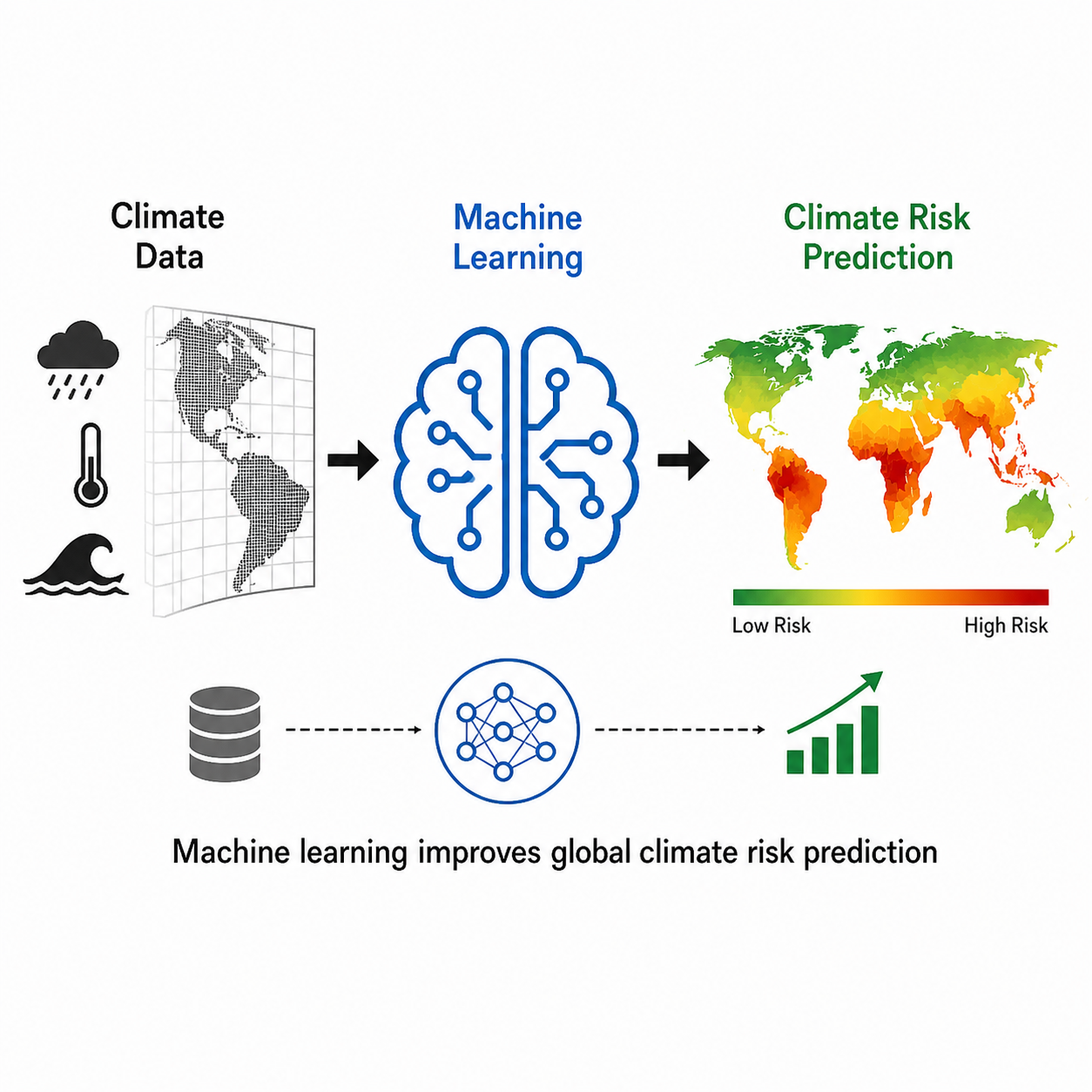
Climate change has significantly increased the complexity and uncertainty associated with environmental risk governance, requiring advanced predictive models capable of supporting decision-making processes under dynamic and nonlinear conditions. This study develops a comparative analytical framework to evaluate the performance of three machine learning models—Random Forest (RF), XGBoost, and Long Short-Term Memory (LSTM)—for climate risk prediction using global environmental datasets. The research adopts a quantitative model-based design, integrating multi-variable data including temperature, CO₂ emissions, precipitation levels, and extreme weather events over the period 2000–2025. Model performance is assessed through k-fold cross-validation and metrics such as RMSE, MAE, and predictive accuracy. The results indicate that XGBoost achieves the highest predictive performance in structured datasets, while LSTM demonstrates superior capacity for temporal pattern recognition. Despite these advances, the analysis reveals a structural limitation: current predictive models are rarely integrated into governance frameworks. This study contributes by: (1) providing a comparative evaluation of machine learning models in climate risk prediction, (2) proposing an integrated analytical approach linking AI and governance, and (3) offering a replicable methodological framework for data-driven environmental decision systems.Downloads
Download data is not yet available.
Published
2026-02-15
How to Cite
Avila Lopez, L. (2026). Comparative Machine Learning Models for Climate Risk Governance: Evidence from Global Environmental Datasets. International Journal of Management Science and Operations Research, 11(1). Retrieved from https://ijmsoridi.com/index.php/ijmsor/article/view/156
Section
PAPERS
Published papers are the exclusive responsibility of their authors and do not necessary reflect the opinions of the editorial committee.
IJMSOR respects the moral rights of its authors, whom must cede the editorial committee the patrimonial rights of the published material. In turn, the authors inform that the current work is unpublished and has not been previously published.
This work is licensed under a Creative Commons Attribution-NonCommercial-NoDerivs 3.0 Unported License.