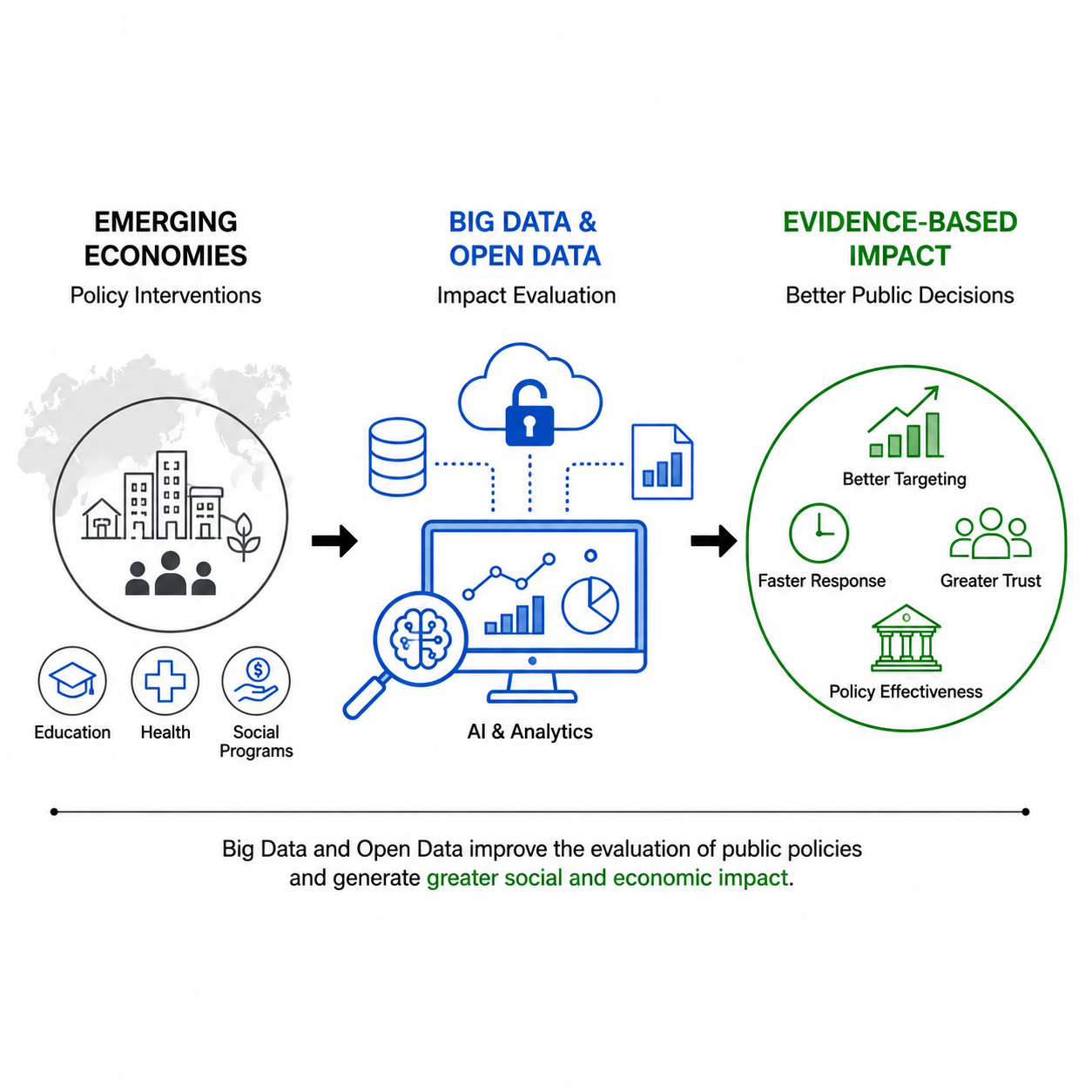
Uso de Big Data para medir impactos sociales y económicos de políticas públicas
Abstract
Este artículo analiza el uso de Big Data como herramienta estratégica para la evaluación de políticas públicas en economías emergentes. A través de una metodología mixta que combina una revisión sistemática de literatura (2019–2024) y un análisis comparado de casos en Colombia, Perú, Nigeria e Indonesia, se examina cómo los datos masivos permiten mejorar la precisión, rapidez y transparencia en la medición de impactos sociales y económicos. Los resultados evidencian que la aplicación de inteligencia artificial, algoritmos de segmentación y plataformas de datos abiertos ha contribuido a reducir los tiempos de respuesta institucional, optimizar la focalización de intervenciones sociales y fortalecer la confianza ciudadana. Se concluye que el Big Data no solo moderniza los sistemas de monitoreo, sino que redefine la relación entre Estado, datos y ciudadanía.Downloads
References
Alzubaidi, L., Zhang, J., Humaidi, A. J., Al-Dujaili, A., Duan, Y., Al-Shamma, O., Santamaría, J., Fadhel, M. A., Al-Amidie, M., & Farhan, L. (2021). Review of deep learning: concepts, CNN architectures, challenges, applications, future directions. Journal of Big Data, 8(1), 53. https://doi.org/10.1186/s40537-021-00444-8:contentReference[oaicite:5]{index=5}
Big Data & Society. (n.d.). Big Data & Society. Retrieved April 21, 2025, from https://journals.sagepub.com/home/bdsSAGE Journals
Bravo, R., Méndez, M., & Santamaría, P. (2020). Datos para combatir crisis y construir sociedades resilientes. Revista Iberoamericana de Gobierno Digital, 5(2), 45–60. https://doi.org/10.5281/zenodo.4567890
Chen, H., Chiang, R. H. L., & Storey, V. C. (2023). Smart cities and data-driven policy: Toward predictive government analytics. Technological Forecasting and Social Change, 190, 122403. https://doi.org/10.1016/j.techfore.2023.122403
Dataphyte. (2024). Leveraging data for accountability in Nigeria. https://dataphyte.org/publications/
De Mauro, A., Greco, M., & Grimaldi, M. (2020). Text mining for policy evaluation: A big data analytics approach. Technological Forecasting and Social Change, 157, 120097. https://doi.org/10.1016/j.techfore.2020.120097
Floridi, L., Cowls, J., Beltrametti, M., Chiarello, F., et al. (2018). AI4People—An ethical framework for a good AI society: Opportunities, risks, principles, and recommendations. Minds and Machines, 28(4), 689–707. https://doi.org/10.1007/s11023-018-9482-5
Frontiers in Big Data. (n.d.). Frontiers in Big Data. Retrieved April 21, 2025, from https://www.frontiersin.org/journals/big-data
García, C., Montesino, A., & Ortiz, L. (2023). Observatorios ciudadanos como innovación en la evaluación de políticas públicas. Revista Latinoamericana de Políticas Públicas, 15(1), 57–78.
Hilbert, M. (2020). Digital data for development: Opportunities and challenges. Information Technology for Development, 26(3), 477–493. https://doi.org/10.1080/02681102.2020.1754625
Janssen, M., & Kuk, G. (2016). The challenges and limits of Big Data algorithms in technocratic governance. Government Information Quarterly, 33(3), 371–377. https://doi.org/10.1016/j.giq.2016.08.011
Kitchin, R. (2014). The data revolution: Big Data, open data, data infrastructures and their consequences. SAGE Publications.
Mayer-Schönberger, V., & Cukier, K. (2013). Big Data: A revolution that will transform how we live, work, and think. Houghton Mifflin Harcourt.
Meijer, A., Curtin, D., & Hillebrandt, M. (2020). Open government and the transparency paradox. International Review of Administrative Sciences, 86(1), 1–11. https://doi.org/10.1177/0020852317750048
Montes de Oca, E., Zamalloa, A., & Ruíz, G. (2023). Análisis del uso de Big Data en la gestión social de gobiernos subnacionales del Perú. Revista de Gobierno Digital y Transparencia, 5(2), 45–61.
OECD. (2025). Improving Policy Evaluation Capacity in Government. OECD Publishing. https://www.oecd.org/gov/policy-evaluation
Sivarajah, U., Kamal, M. M., Irani, Z., & Weerakkody, V. (2017). Critical analysis of Big Data challenges and analytical methods. Journal of Business Research, 70, 263–286. https://doi.org/10.1016/j.jbusres.2016.08.001
Sun, T. Q., Medaglia, R., & Zhang, J. (2021). Leveraging big data for public policy evaluation: An integrated model. Government Information Quarterly, 38(4), 101611. https://doi.org/10.1016/j.giq.2021.101611
Ubaldi, B. (2013). Open government data: Towards empirical analysis of open government data initiatives. OECD Working Papers on Public Governance, No. 22.
Zambrano, R. A., Young, C., & Verhulst, S. G. (2019). The data revolution in international development: Big Data for development. UNDP Global Centre for Technology, Innovation and Sustainable Development.
Zhao, W., & Yaakop, M. (2024). Mapping the field of digital governance research: A bibliometric analysis from 2019 to 2023. Government Information Quarterly, 41(1), 101771. https://doi.org/10.1016/j.giq.2023.101771
Published papers are the exclusive responsibility of their authors and do not necessary reflect the opinions of the editorial committee.
IJMSOR respects the moral rights of its authors, whom must cede the editorial committee the patrimonial rights of the published material. In turn, the authors inform that the current work is unpublished and has not been previously published.
This work is licensed under a Creative Commons Attribution-NonCommercial-NoDerivs 3.0 Unported License.