Algorithmic Governance and Digital Ethics: An Organizational Approach to Automated Decision-Making
Abstract
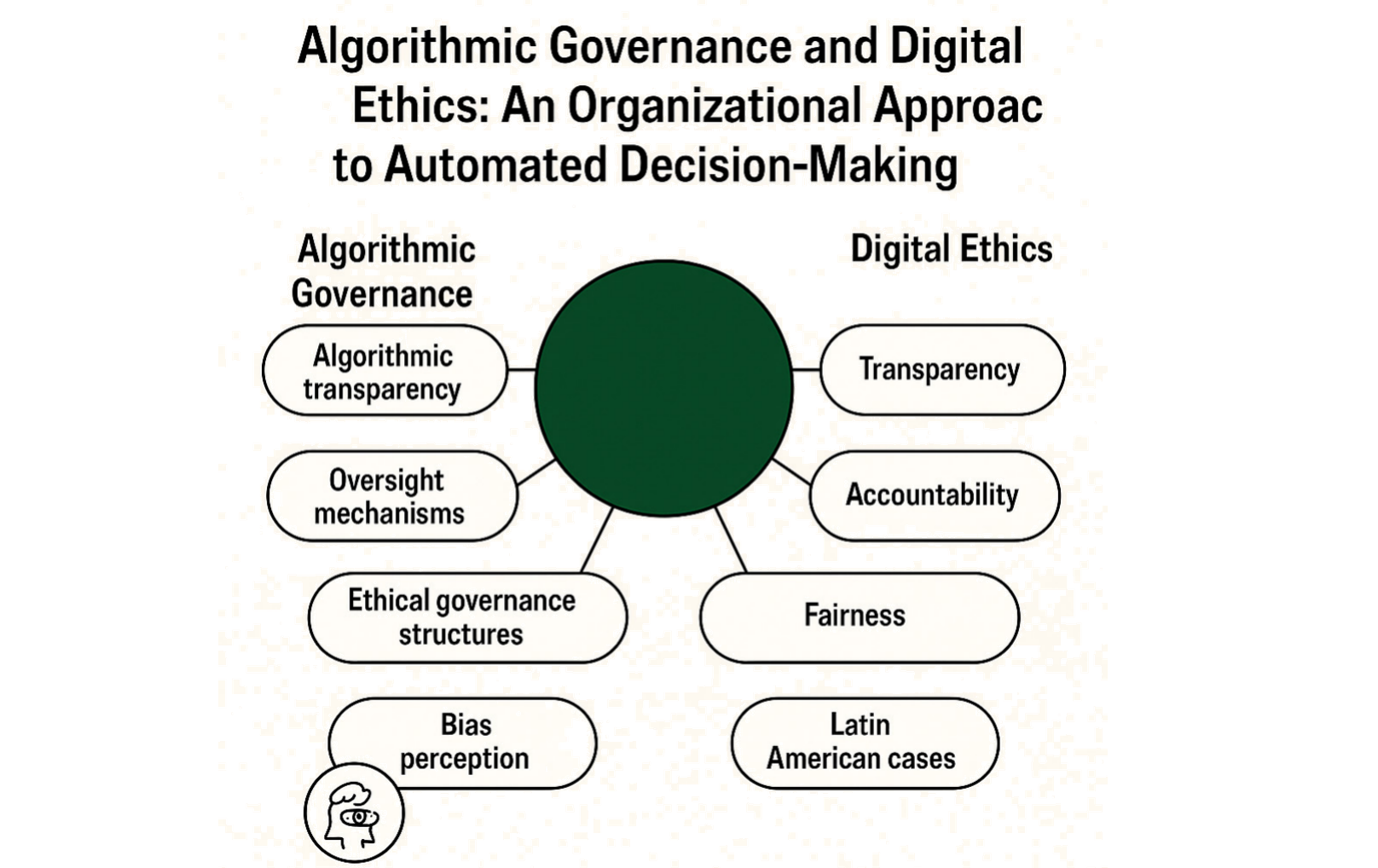
Automated decision-making systems have fundamentally reshaped organizational power structures; however, there is limited empirical evidence on how algorithmic governance and digital ethics are operationalized as measurable organizational capabilities, particularly in emerging economies. This study analyzes the state of algorithmic governance and digital ethics in 120 organizations across Argentina, Brazil, Chile, and Uruguay using a quantitative approach based on structured instruments, exploratory factor analysis, and hierarchical clustering. Four key dimensions were assessed: algorithmic transparency, supervision and audit mechanisms, ethical governance structures, and institutional perception of bias. The results reveal moderate levels of transparency (M = 3.38), low institutionalization of audit mechanisms (M = 2.87), and weak adoption of formal ethical frameworks (M = 2.82), alongside a significant gap between bias awareness (61%) and mitigation practices (40%). Cluster analysis identifies that only 22% of organizations exhibit a proactive ethical governance profile. These findings demonstrate that digital ethics remains weakly integrated into organizational strategy, limiting the capacity to ensure fair and accountable automated decision-making. Based on this evidence, the study proposes an organizational governance framework that integrates transparency, ethical oversight, and institutional accountability as core components of algorithmic systems. This research contributes empirical evidence on the structural conditions required to advance responsible AI governance in Latin American organizations.Downloads
References
Batool, A., Faheem, M., Naseem, R., & Butt, W. H. (2025). Artificial intelligence governance: A systematic literature review. Journal of Responsible Technology, 14, 100197. https://doi.org/10.1016/j.jrt.2023.100197
Davenport, T. H., Guha, A., Grewal, D., & Bressgott, T. (2023). How artificial intelligence will change the future of business. Journal of the Academy of Marketing Science, 51(1), 24–42. https://doi.org/10.1007/s11747-022-00839-2
Dwivedi, Y. K., et al. (2023). Multidisciplinary perspectives on generative AI. International Journal of Information Management, 71, 102642. https://doi.org/10.1016/j.ijinfomgt.2023.102642
Eubanks, V. (2018). Automating inequality: How high-tech tools profile, police, and punish the poor. St. Martin's Press.
Floridi, L., & Cowls, J. (2019). A unified framework of five principles for AI in society. Harvard Data Science Review, 1(1). https://doi.org/10.1162/99608f92.8cd550d1
Jobin, A., Ienca, M., & Vayena, E. (2019). The global landscape of AI ethics guidelines. Nature Machine Intelligence, 1, 389–399. https://doi.org/10.1038/s42256-019-0088-2
Linnenluecke, M. K. (2023). Resilience in business and management research. International Journal of Management Reviews, 25(2), 234–260. https://doi.org/10.1111/ijmr.12280
Mökander, J., Polonska, A., Larsson, S., & Floridi, L. (2021). Ethics-based auditing to develop trustworthy AI: A conceptual framework and research agenda. AI and Ethics, 1, 465–478. https://doi.org/10.1007/s43681-021-00038-5
Nambisan, S., Wright, M., & Feldman, M. (2023). The digital transformation of innovation. Research Policy, 52(1), 104652
OECD. (2021). OECD Framework for the Classification of AI Systems. OECD Publishing. https://www.oecd.org/going-digital/ai/classification/
Starke, C., Lünich, M., & Marcinkowski, F. (2021). Fairness perceptions of algorithmic decision-making: A systematic review of the empirical literature. Information, Communication & Society, 26(1), 1–20. https://doi.org/10.1080/1369118X.2021.1950891
UNESCO. (2021). Recommendation on the Ethics of Artificial Intelligence. United Nations Educational, Scientific and Cultural Organization. https://unesdoc.unesco.org/ark:/48223/pf0000381137
Wachter, S., Mittelstadt, B., & Floridi, L. (2017). Why a right to explanation of automated decision-making does not exist in the General Data Protection Regulation. International Data Privacy Law, 7(2), 76–99. https://doi.org/10.1093/idpl/ipx005
Wright, D., & Kreissl, R. (Eds.). (2014). Surveillance in Europe. Routledge.
Yeung, K. (2018). Algorithmic regulation: A critical interrogation. Regulation & Governance, 12(4), 505–523. https://doi.org/10.1111/rego.12160
Zuboff, S. (2019). The age of surveillance capitalism: The fight for a human future at the new frontier of power. PublicAffairs.
Published papers are the exclusive responsibility of their authors and do not necessary reflect the opinions of the editorial committee.
IJMSOR respects the moral rights of its authors, whom must cede the editorial committee the patrimonial rights of the published material. In turn, the authors inform that the current work is unpublished and has not been previously published.
This work is licensed under a Creative Commons Attribution-NonCommercial-NoDerivs 3.0 Unported License.