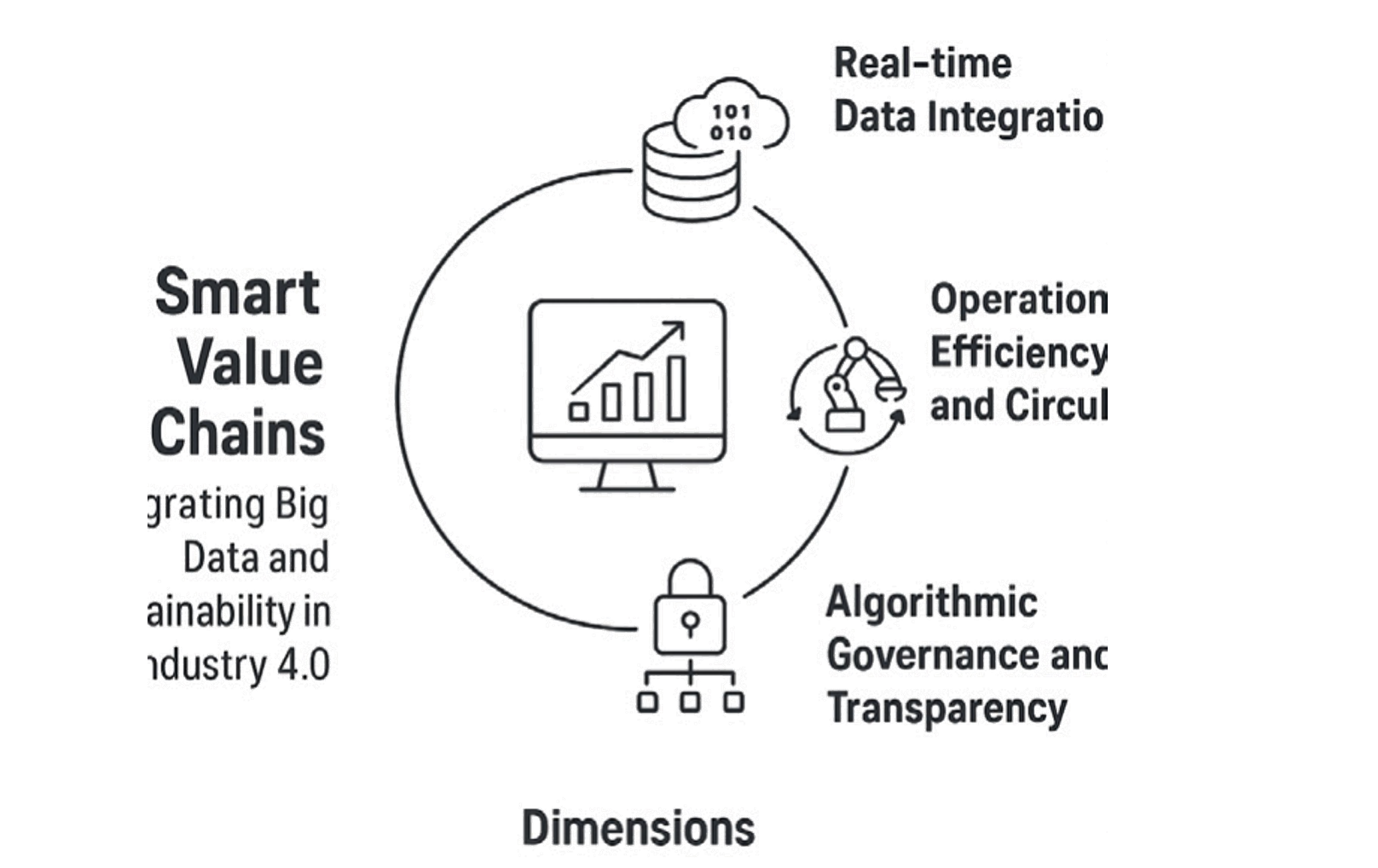
Smart Value Chains: Integrating Big Data and Sustainability in Industry 4.0
Abstract
The integration of Big Data and Industry 4.0 technologies has been widely associated with improvements in operational efficiency and sustainability; however, there is limited empirical evidence explaining how data-driven capabilities simultaneously influence circularity, governance, and transparency within industrial value chains. This study analyzes the impact of Big Data integration on sustainable performance through a quantitative explanatory design based on survey data collected from industrial organizations between May and October 2024. The analysis combines exploratory factor analysis, multiple linear regression, and Pearson correlation to examine three key dimensions: real-time data integration, operational efficiency and circularity, and algorithmic governance and transparency. The results reveal high levels of implementation in real-time data integration (M = 4.12) and operational circularity (R² = 0.42), with strong positive correlations between data integration and sustainability indicators (r = 0.68; p < 0.01). Additionally, algorithmic governance explains 35% of the variance in sustainable governance outcomes, highlighting the role of data governance in ensuring transparency and accountability. These findings demonstrate that Big Data capabilities act as a structural enabler of both operational and environmental performance. Based on this evidence, the study proposes a smart value chain framework that integrates analytics, governance, and circularity as core dimensions of sustainable Industry 4.0 systems. This research contributes empirical evidence on the systemic role of data-driven transformation in advancing sustainable industrial ecosystems.Downloads
References
Bag, S., Gupta, S., Kumar, A., & Sivarajah, U. (2023). Role of big data analytics in sustainable supply chains. Technological Forecasting and Social Change
Bai, C., Zhang, X., & Zhou, H. (2020). The impact of big data analytics on supply chain sustainability: A literature review and future directions. Journal of Cleaner Production, 275, 124110. https://doi.org/10.1016/j.jclepro.2020.124110
Chen, J., Xu, L., & Shi, X. (2021). Cyber-physical systems and big data: An integrated approach for manufacturing system design. Computers in Industry, 129, 103426. https://doi.org/10.1016/j.compind.2021.103426
Dubey, R., Gunasekaran, A., & Childe, S. (2023). Big data analytics and sustainability. Journal of Cleaner Production
Floridi, L., Taddeo, M., & Turilli, M. (2018). The ethics of big data: The machine learning paradigm. Ethics and Information Technology, 20(4), 293-305. https://doi.org/10.1007/s10676-018-9462-4
Frank, A. G., Dalenogare, L. S., & Ayala, N. F. (2023). Industry 4.0 technologies and performance. Production Planning & Control
Ivanov, D., Dolgui, A., & Sokolov, B. (2023). Digital supply chain and resilience. International Journal of Production Research
Kamble, S. S., Gunasekaran, A., & Dhone, N. C. (2020). Industry 4.0 and lean manufacturing practices for sustainable organizational performance in Indian manufacturing companies. International Journal of Production Economics, 231, 107862. https://doi.org/10.1016/j.ijpe.2020.107862
Kouhizadeh, M., Sarkis, J., & Zhu, Q. (2023). Data governance in sustainable supply chains. Journal of Business Ethics
Lu, Y., & Xu, X. (2020). Smart manufacturing and big data: A perspective on the future of the manufacturing industry. Advanced Engineering Informatics, 45, 101143. https://doi.org/10.1016/j.aei.2020.101143
Mikalef, P., Krogstie, J., Pappas, I. O., & Giannakos, M. (2020). Investigating the effects of big data analytics capabilities on firm performance: The mediating role of dynamic capabilities. Information & Management, 57(2), 103169. https://doi.org/10.1016/j.im.2019.103169
Porter, M. E., & Heppelmann, J. E. (2014). How smart, connected products are transforming competition. Harvard Business Review, 92(11), 64-88.
Schwab, K. (2016). The Fourth Industrial Revolution. World Economic Forum.
Schwab, K. (2016). The Fourth Industrial Revolution. World Economic Forum.
Wamba-Taguimdje, S. L., Fosso Wamba, S., Kala Kamdjoug, J. R., & Tchatchouang Wanko, C. E. (2020). Influence of artificial intelligence (AI) on firm performance: The business value of AI-based transformation projects. Business Process Management Journal, 26(7), 1893–1924. https://doi.org/10.1108/BPMJ-10-2019-0411
Wirtz, B. W., Weyerer, J. C., & Geyer, C. (2023). Artificial intelligence and governance. Government Information Quarterly
Published papers are the exclusive responsibility of their authors and do not necessary reflect the opinions of the editorial committee.
IJMSOR respects the moral rights of its authors, whom must cede the editorial committee the patrimonial rights of the published material. In turn, the authors inform that the current work is unpublished and has not been previously published.
This work is licensed under a Creative Commons Attribution-NonCommercial-NoDerivs 3.0 Unported License.