Knowledge Network Analysis in Universities: Open Innovation and Academic Governance
Abstract
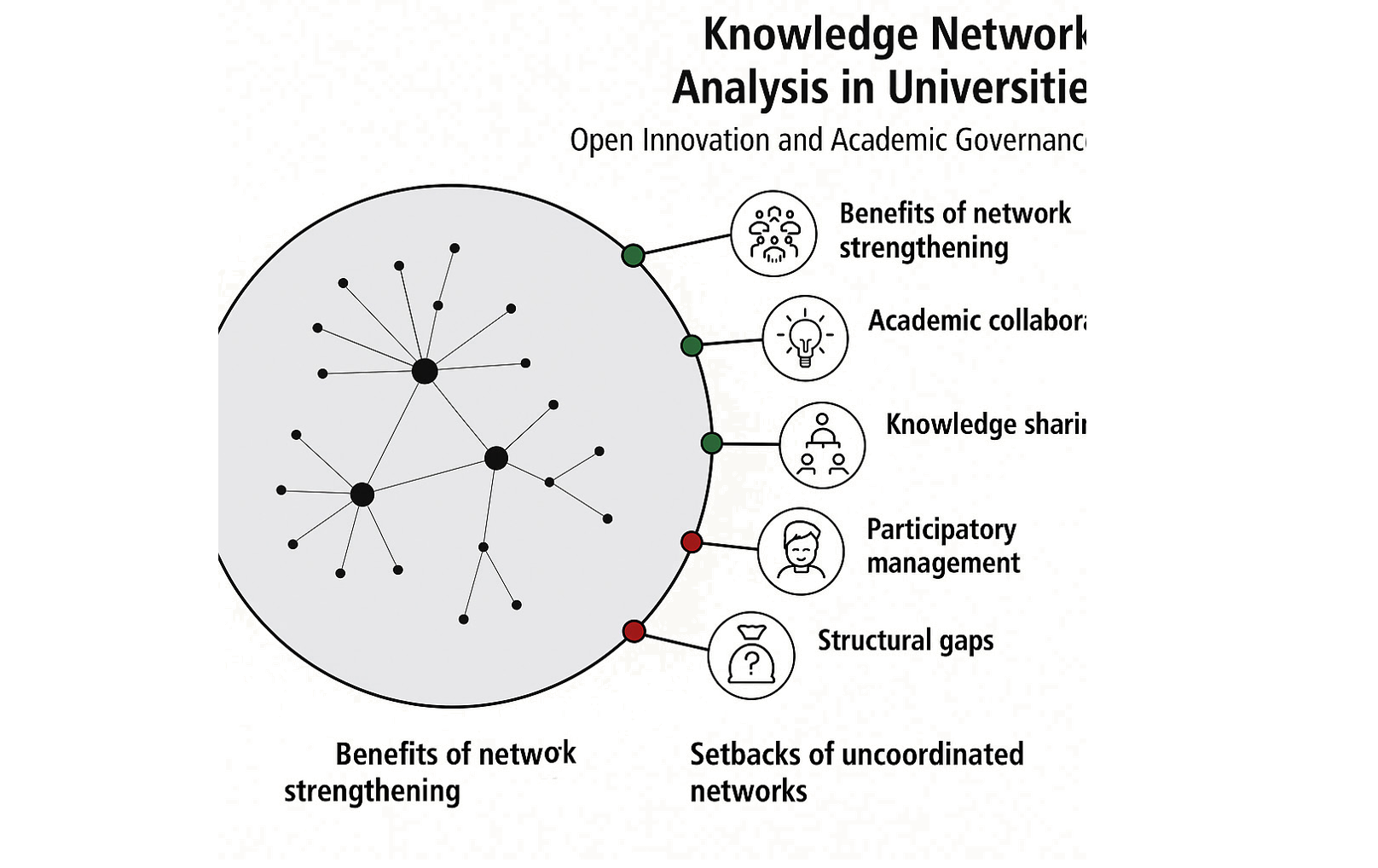
Knowledge networks have become a central mechanism for driving open innovation and reshaping governance structures in universities; however, there is still limited empirical evidence explaining how internal network configurations influence institutional openness and decision-making dynamics, particularly in emerging contexts. This study analyzes the structure and strategic effects of knowledge networks in Latin American universities using a quantitative approach based on social network analysis (SNA) applied to three public institutions in Colombia, Peru, and Mexico. The findings reveal highly centralized network structures, low overall density, and the presence of informal communities that operate beyond formal organizational boundaries. Strong positive correlations were identified between institutional openness and network cohesion (ρ = 0.81; p < 0.01), as well as between actor centrality and participation in governance processes. These results demonstrate that network configuration directly shapes both knowledge flows and institutional decision-making capacity. Based on this evidence, the study proposes a network-based governance framework that integrates open innovation mechanisms with distributed decision-making structures. The article contributes to the literature by providing empirical validation of the relationship between network dynamics, openness, and governance, offering a scalable model for transforming universities into adaptive, collaborative, and strategically oriented ecosystems.Downloads
References
Amaral, A., Meek, V. L., & Larsen, I. M. (2003). The Higher Education Managerial Revolution? Springer.
Benitez, J., Ray, G., & Henseler, J. (2023). Impact of digital networks on organizational performance. Journal of Management Information Systems
Bernasconi, A. (2006). Does the affiliation of universities to external organizations foster their academic performance? Higher Education Policy, 19(1), 45–62. https://doi.org/10.1057/palgrave.hep.8300104
Bleiklie, I., & Kogan, M. (2007). Organization and governance of universities. Higher Education Policy, 20(4), 477–493. https://doi.org/10.1057/palgrave.hep.8300167
Borgatti, S. P., Everett, M. G., & Johnson, J. C. (2022). Analyzing social networks. SAGE
Carayannis, E. G., & Campbell, D. F. J. (2009). 'Mode 3' and 'Quadruple Helix': Toward a 21st century fractal innovation ecosystem. International Journal of Technology Management, 46(3–4), 201–234. https://doi.org/10.1504/IJTM.2009.023374
Chesbrough, H. W. (2003). Open Innovation: The New Imperative for Creating and Profiting from Technology. Harvard Business Press.
Chesbrough, H., & Brunswicker, S. (2014). Managing open innovation in large firms: Survey report. Fraunhofer Verlag.
Cross, R., Rebele, R., & Grant, A. (2023). Collaborative networks and performance. Harvard Business Review
De Boer, H., Enders, J., & Schimank, U. (2007). On the way towards New Public Management? The governance of university systems in England, the Netherlands, Austria, and Germany. In D. Jansen (Ed.), New forms of governance in research organizations (pp. 137–152). Springer.
De Fuentes, C., & Dutrénit, G. (2012). Best channels of academia–industry interaction for long-term benefit. Research Policy, 41(9), 1666–1682. https://doi.org/10.1016/j.respol.2012.03.026
De Silva, M., Howells, J., & Meyer, M. (2021). Innovation intermediaries and collaboration: Influence mechanisms in university-industry interactions. Research Policy, 50(1), 104109. https://doi.org/10.1016/j.respol.2020.104109
Etzkowitz, H., & Leydesdorff, L. (2000). The dynamics of innovation: from National Systems and “Mode 2” to a Triple Helix of university–industry–government relations. Research Policy, 29(2), 109–123.
Freeman, C. (1991). Networks of innovators: A synthesis of research issues. Research Policy, 20(5), 499–514. https://doi.org/10.1016/0048-7333(91)90072-X
Gulati, R., Lavie, D., & Madhavan, R. (2023). Network resources and firm performance. Strategic Management Journal
Jongbloed, B., Enders, J., & Salerno, C. (2008). Higher education and its communities: Interconnections, interdependencies and a research agenda. Higher Education, 56(3), 303–324. https://doi.org/10.1007/s10734-008-9128-2
Kehm, B. M., & Lanzendorf, U. (2006). Reforming university governance. Springer.
Laursen, K., & Salter, A. (2006). Open for innovation: The role of openness in explaining innovation performance among U.K. manufacturing firms. Strategic Management Journal, 27(2), 131–150. https://doi.org/10.1002/smj.507
Marginson, S. (2022). Higher education and the common good: A global perspective. Studies in Higher Education, 47(3), 489–502. https://doi.org/10.1080/03075079.2020.1843156
Perkmann, M., Tartari, V., McKelvey, M., Autio, E., Broström, A., D’Este, P., ... & Sobrero, M. (2013). Academic engagement and commercialisation: A review of the literature on university–industry relations. Research Policy, 42(2), 423–442.
Powell, W. W., Koput, K. W., & Smith-Doerr, L. (1996). Interorganizational collaboration and the locus of innovation: Networks of learning in biotechnology. Administrative Science Quarterly, 41(1), 116–145. https://doi.org/10.2307/2393988
Vanhaverbeke, W., Chesbrough, H., & West, J. (2014). Open innovation: Researching a new paradigm. Oxford University Press.
Wamba-Taguimdje, S. L., Fosso Wamba, S., Kala Kamdjoug, J. R., & Tchatchouang Wanko, C. E. (2020). Influence of artificial intelligence (AI) on firm performance: The business value of AI-based transformation projects. Business Process Management Journal, 26(7), 1893–1924. https://doi.org/10.1108/BPMJ-10-2019-0411
Wasserman, S., & Faust, K. (1994). Social Network Analysis: Methods and Applications. Cambridge University Press.
West, J., & Bogers, M. (2021). Open innovation: Current status and research opportunities. Innovation: Organization & Management, 23(1), 1–10. https://doi.org/10.1080/14479338.2021.1977570
Published papers are the exclusive responsibility of their authors and do not necessary reflect the opinions of the editorial committee.
IJMSOR respects the moral rights of its authors, whom must cede the editorial committee the patrimonial rights of the published material. In turn, the authors inform that the current work is unpublished and has not been previously published.
This work is licensed under a Creative Commons Attribution-NonCommercial-NoDerivs 3.0 Unported License.