AI-Driven Sustainability Strategies: A Business Model for Emerging Economies
Abstract
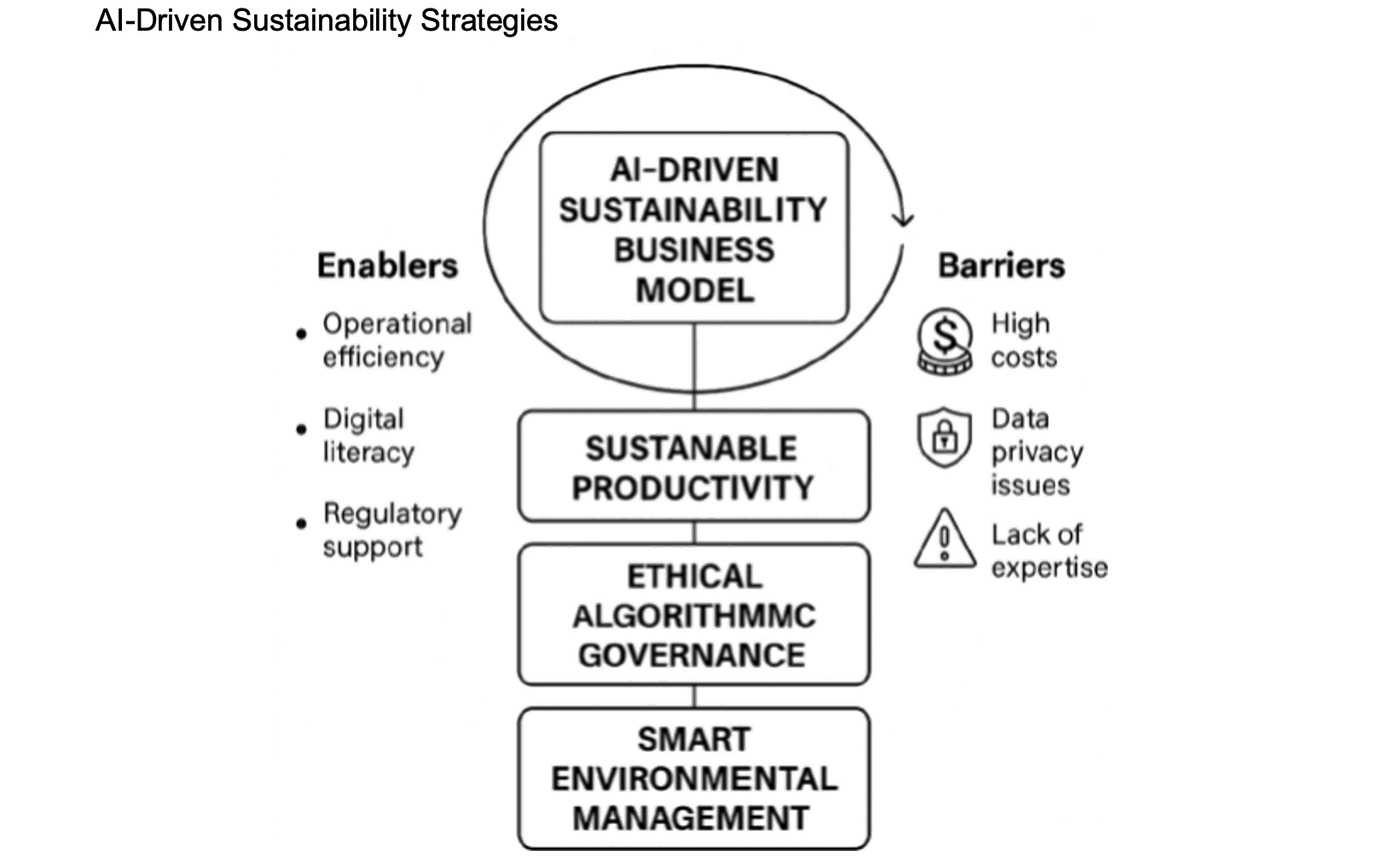
Artificial intelligence (AI) and business sustainability have emerged as critical drivers of organizational transformation in emerging economies; however, the absence of integrative frameworks that connect technological, organizational, and strategic dimensions limits their effective implementation. This study develops an adaptive AI-driven business sustainability model through a sequential mixed-methods design applied to 25 Latin American companies. The research combines exploratory factor analysis, hierarchical clustering, multiple correspondence analysis, and qualitative coding of semi-structured interviews to identify structural patterns and emerging variables. The results reveal three core dimensions—sustainable productivity, ethical algorithmic governance, and smart environmental management—along with four technological adoption profiles and seven key emerging variables associated with ESG integration. Based on these findings, a systemic framework structured across operational, organizational, and strategic levels is proposed, incorporating feedback mechanisms to enable progressive and context-sensitive implementation. This study contributes to the literature by providing empirically grounded evidence and a scalable roadmap for aligning AI capabilities with sustainability goals, positioning AI as a systemic enabler of responsible and adaptive transformation in high-uncertainty environments.Downloads
References
Arenas-Marquez, F. J., Paternina-Arboleda, C. D., & García, A. (2021). AI in logistics: Optimization and sustainability perspectives. Journal of Cleaner Production, 289, 125636. https://doi.org/10.1016/j.jclepro.2021.125636
Bag, S., Wood, L. C., Xu, L., Dhamija, P., & Kayikci, Y. (2021). Big data analytics as an operational excellence approach to enhance sustainable supply chain performance. Resources, Conservation and Recycling, 164, 105119. https://doi.org/10.1016/j.resconrec.2020.105119
Bai, C., Dallasega, P., Orzes, G., & Sarkis, J. (2021). Industry 4.0 technologies assessment: A sustainability perspective. International Journal of Production Economics, 229, 107776. https://doi.org/10.1016/j.ijpe.2020.107776
Binns, R. (2018). Fairness in machine learning: Lessons from political philosophy. Proceedings of the 2018 Conference on Fairness, Accountability and Transparency, 149–159.
Chatterjee, S., Rana, N. P., Tamilmani, K., & Sharma, A. (2021). The next generation of responsible AI: A review and research agenda. International Journal of Information Management, 60, 102383. https://doi.org/10.1016/j.ijinfomgt.2021.102383
Conz, E., Denicolai, S., & Zucchella, A. (2023). Resilience strategies in business ecosystems. Long Range Planning, 56(1), 102180. https://doi.org/10.1016/j.lrp.2021.102180
Davenport, T. H., Guha, A., Grewal, D., & Bressgott, T. (2023). AI and business transformation. Journal of the Academy of Marketing Science, 51(1), 24–42. https://doi.org/10.1007/s11747-022-00839-2
Del Río, P., Morales, I., & Sandoval, D. (2023). Artificial intelligence and sustainable innovation in Latin America: An institutional framework. Sustainable Futures, 5, 100120. https://doi.org/10.1016/j.sftr.2023.100120
Dwivedi, Y. K., et al. (2023). Multidisciplinary perspectives on generative AI. International Journal of Information Management, 71, 102642. https://doi.org/10.1016/j.ijinfomgt.2023.102642
Dwivedi, Y. K., Hughes, D. L., Ismagilova, E., Aarts, G., Coombs, C., Crick, T., ... & Williams, M. D. (2021). Artificial Intelligence (AI): Multidisciplinary perspectives on emerging challenges, opportunities, and agenda for research, practice and policy. International Journal of Information Management, 57, 101994. https://doi.org/10.1016/j.ijinfomgt.2019.08.002
George, G., Merrill, R. K., & Schillebeeckx, S. J. D. (2023). Digital sustainability and entrepreneurship. Journal of Business Venturing, 38(1), 106260. https://doi.org/10.1016/j.jbusvent.2022.106260
Ghobakhloo, M., Iranmanesh, M., Rezaei, S., & Maroufkhani, P. (2021). Industry 4.0, smart factory, and sustainable manufacturing: An integrative framework. European Journal of Operational Research, 297(2), 541–556. https://doi.org/10.1016/j.ejor.2021.05.048
Guszcza, J., Lewis, H., & Evans-Greenwood, P. (2020). Human-centered AI: The key to successful AI implementation. Deloitte Review, (27), 12–25.
Jarrahi, M. H. (2018). Artificial intelligence and the future of work: Human-AI symbiosis in organizational decision making. Business Horizons, 61(4), 577–586.
Kamble, S. S., Gunasekaran, A., & Gawankar, S. A. (2020). Achieving sustainable performance in a data-driven agriculture supply chain: A review for research and applications. Technological Forecasting and Social Change, 152, 119899. https://doi.org/10.1016/j.techfore.2020.119899
Kraus, S., Schiavone, F., Pluzhnikova, A., & Invernizzi, A. (2023). Digital transformation in SMEs. Journal of Business Research, 145, 65–78. https://doi.org/10.1016/j.jbusres.2022.01.014
Lee, J., Kao, H. A., & Yang, S. (2021). Service innovation and smart analytics for Industry 4.0 and big data environment. Procedia CIRP, 16, 3–8. https://doi.org/10.1016/j.procir.2021.03.002
Li, F., Nucciarelli, A., Roden, S., & Graham, G. (2023). How digital transformation reshapes business models: A systematic review. Technological Forecasting and Social Change, 188, 122284. https://doi.org/10.1016/j.techfore.2022.122284
Linnenluecke, M. K. (2023). Resilience in business and management research. International Journal of Management Reviews, 25(2), 234–260. https://doi.org/10.1111/ijmr.12280
Mikalef, P., Krogstie, J., Pappas, I. O., & Pavlou, P. A. (2019). Investigating the effects of big data analytics capabilities on firm performance: The mediating role of dynamic capabilities. Information & Management, 56(8), 103207. https://doi.org/10.1016/j.im.2018.12.003
Moktadir, M. A., Rahman, T., Rahman, M. H., Ali, S. M., & Paul, S. K. (2020). Drivers to sustainable manufacturing practices and circular economy: A perspective of leather industries in Bangladesh. Journal of Cleaner Production, 251, 119737. https://doi.org/10.1016/j.jclepro.2019.119737
Nambisan, S., Wright, M., & Feldman, M. (2023). The digital transformation of innovation and entrepreneurship. Research Policy, 52(1), 104652. https://doi.org/10.1016/j.respol.2022.104652
Nudurupati, S. S., Tebboune, S., & Hardman, G. (2021). Performance measurement and management in operations: Research gaps and new directions. International Journal of Operations & Production Management, 41(3), 260–303. https://doi.org/10.1108/IJOPM-12-2019-0777
Raj, A., Dwivedi, G., Sharma, A., & Tiwari, M. K. (2020). Barriers to the adoption of industry 4.0 technologies in the manufacturing sector: An inter-country comparative perspective. Technological Forecasting and Social Change, 159, 120153. https://doi.org/10.1016/j.techfore.2020.120153
Rodríguez, J., & Ceballos, S. (2022). Inteligencia artificial y sostenibilidad en América Latina: Avances y desafíos. Revista de Innovación y Sociedad, 10(2), 115–132.
Shamim, S., Cang, S., Yu, H., & Li, Y. (2022). Leadership behaviors, emotional intelligence, and digital transformation: A multilevel study. Technological Forecasting and Social Change, 174, 121273. https://doi.org/10.1016/j.techfore.2021.121273
Singh, R. K., Gupta, S., & Gunasekaran, A. (2022). AI adoption in SMEs for sustainable performance: A multistage model. Sustainable Production and Consumption, 29, 13–27. https://doi.org/10.1016/j.spc.2021.09.004
Sodhi, M. S., & Tang, C. S. (2022). Research opportunities in AI and supply chain management. International Journal of Production Research, 60(12), 3812–3822. https://doi.org/10.1080/00207543.2021.1988774
Wamba-Taguimdje, S. L., Fosso Wamba, S., Kala Kamdjoug, J. R., & Tchatchouang Wanko, C. E. (2020). Influence of artificial intelligence (AI) on firm performance and environmental sustainability. Technological Forecasting and Social Change, 158, 120118. https://doi.org/10.1016/j.techfore.2020.120118
Wamba, S. F., Kala Kamdjoug, J. R., Tchatchouang Wanko, C. E., & Fosso Wamba, S. (2021). Influence of artificial intelligence (AI) on firm performance and environmental sustainability. Technological Forecasting and Social Change, 158, 120118. https://doi.org/10.1016/j.techfore.2020.120118
Zhang, Y., Zhang, G., Liu, Y., & Xie, Y. (2022). Real-time energy optimization using deep reinforcement learning in intelligent manufacturing. Journal of Manufacturing Systems, 62, 393–404. https://doi.org/10.1016/j.jmsy.2021.11.004
Published papers are the exclusive responsibility of their authors and do not necessary reflect the opinions of the editorial committee.
IJMSOR respects the moral rights of its authors, whom must cede the editorial committee the patrimonial rights of the published material. In turn, the authors inform that the current work is unpublished and has not been previously published.
This work is licensed under a Creative Commons Attribution-NonCommercial-NoDerivs 3.0 Unported License.