Digital Transformation and Organizational Resilience: Post-Pandemic Management Lessons from Latin America
Abstract
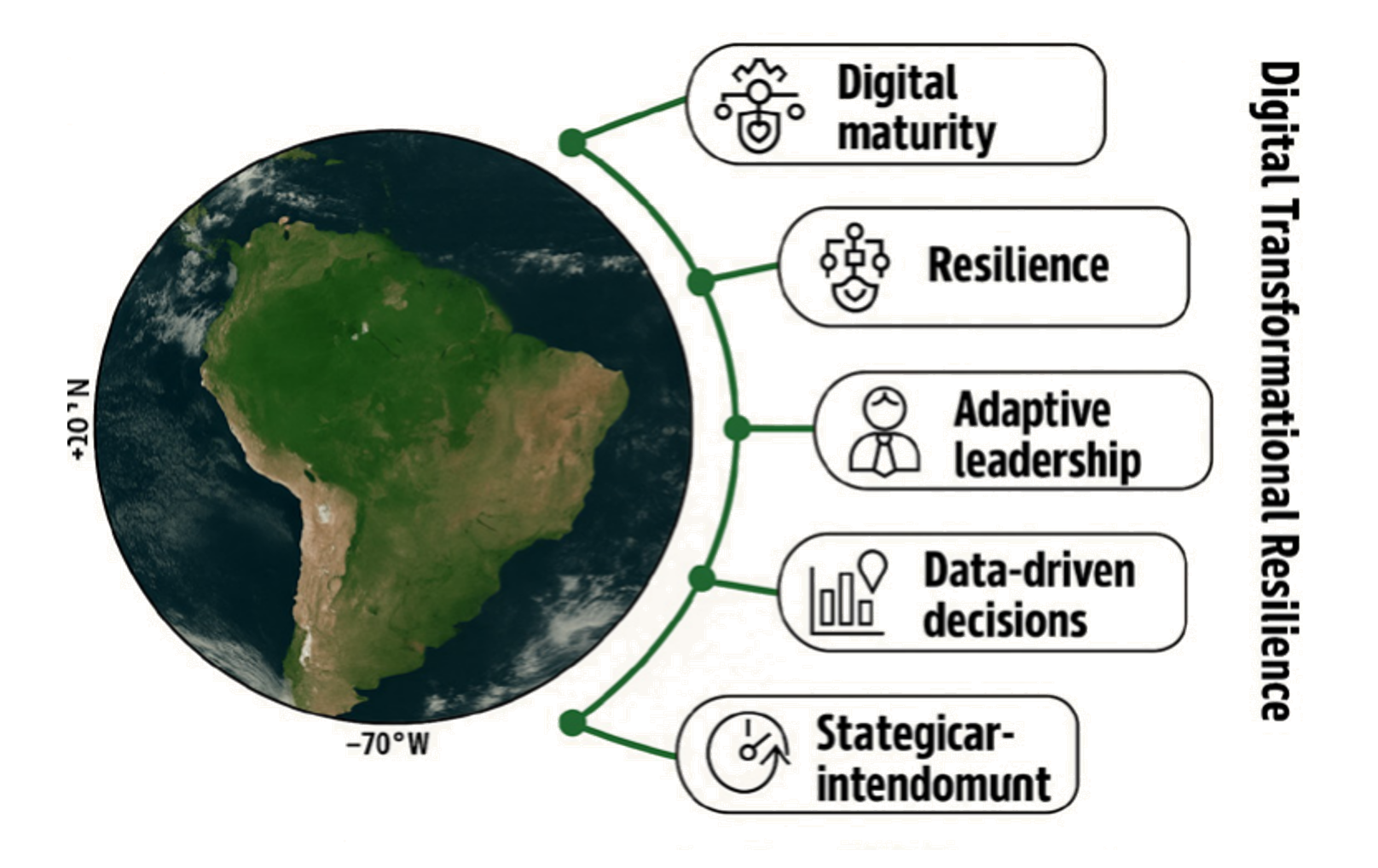
The COVID-19 pandemic exposed critical structural vulnerabilities in Latin American organizations, accelerating the adoption of digital transformation as a strategy for resilience and continuity. However, limited empirical evidence exists on how digital transformation quantitatively enhances organizational resilience in post-pandemic contexts within emerging economies. This study analyzes the impact of digital transformation on organizational resilience through a quasi-experimental design involving 60 organizations across Colombia, Mexico, and Peru. By comparing an experimental group implementing structured digital strategies with a control group maintaining traditional practices, changes in anticipation, adaptation, and organizational learning were measured using validated scales. The results reveal statistically significant improvements in the experimental group (Δ = +1.2, p < 0.001), along with strong positive correlations between digital maturity and resilience dimensions, particularly adaptation (r = 0.81). Based on these findings, the study proposes the Resilient Innovation Model for Latin America (MIRAL), integrating digital training, adaptive leadership, governance, and technological infrastructure. This research contributes empirical evidence from emerging economies and advances the understanding of digital transformation as a strategic capability for building organizational resilience in high-uncertainty environments.Downloads
References
Bharadwaj, A., El Sawy, O. A., Pavlou, P. A., & Venkatraman, N. (2013). Digital business strategy: Toward a next generation of insights. MIS Quarterly, 37(2), 471–482. https://doi.org/10.25300/MISQ/2013/37:2.3
Boin, A., & Van Eeten, M. J. G. (2013). The resilient organization. Public Management Review, 15(3), 429–445. https://doi.org/10.1080/14719037.2013.769856
Conz, E., & Magnani, G. (2020). A dynamic perspective on the resilience of firms: A systematic literature review and a framework for future research. European Management Journal, 38(3), 400–412. https://doi.org/10.1016/j.emj.2019.12.004
Conz, E., Denicolai, S., & Zucchella, A. (2023). Resilience strategies in business ecosystems. Long Range Planning, 56(1), 102180. https://doi.org/10.1016/j.lrp.2021.102180
Davenport, T. H., Guha, A., Grewal, D., & Bressgott, T. (2023). How artificial intelligence will change the future of marketing. Journal of the Academy of Marketing Science, 51(1), 24–42. https://doi.org/10.1007/s11747-022-00839-2
Dwivedi, Y. K., et al. (2023). So what if ChatGPT wrote it? Multidisciplinary perspectives on generative AI. International Journal of Information Management, 71, 102642. https://doi.org/10.1016/j.ijinfomgt.2023.102642
Duchek, S. (2020). Organizational resilience: A capability-based conceptualization. Business Research, 13(1), 215–246. https://doi.org/10.1007/s40685-019-0085-7
Fernández-Aráoz, C. (2020). The most important skill for leaders in a post-COVID world. Harvard Business Review. https://hbr.org/2020/07/the-most-important-skill-for-leaders-in-a-post-covid-world
George, G., Merrill, R. K., & Schillebeeckx, S. J. D. (2023). Digital sustainability and entrepreneurship. Journal of Business Venturing, 38(1), 106260. https://doi.org/10.1016/j.jbusvent.2022.106260
González, M., & Calderón, L. (2022). Transformación digital en tiempos de crisis: Respuestas empresariales en América Latina. Revista Gestión & Sociedad, 11(2), 45–62.
Heifetz, R. A., Grashow, A., & Linsky, M. (2009). The practice of adaptive leadership: Tools and tactics for changing your organization and the world. Harvard Business Press.
Horney, N., Pasmore, B., & O'Shea, T. (2010). Leadership agility: A business imperative for a VUCA world. People and Strategy, 33(4), 32–38.
Kraus, S., Schiavone, F., Pluzhnikova, A., & Invernizzi, A. C. (2023). Digital transformation in SMEs: A systematic literature review. Journal of Business Research, 145, 65–78. https://doi.org/10.1016/j.jbusres.2022.01.014
Kantur, D., & Iseri-Say, A. (2015). Measuring organizational resilience: A scale development. Journal of Business, Economics and Finance, 4(3), 456–472. https://doi.org/10.17261/Pressacademia.2015313063
Lengnick-Hall, C. A., Beck, T. E., & Lengnick-Hall, M. L. (2011). Developing a capacity for organizational resilience through strategic human resource management. Human Resource Management Review, 21(3), 243–255. https://doi.org/10.1016/j.hrmr.2010.07.001
Lengnick-Hall, C. A., Beck, T. E., & Lengnick-Hall, M. L. (2011). Developing a capacity for organizational resilience through strategic human resource management. Human Resource Management Review, 21(3), 243–255. https://doi.org/10.1016/j.hrmr.2010.07.001
Linnenluecke, M. K. (2023). Resilience in business and management research: A review of influential publications and a research agenda. International Journal of Management Reviews, 25(2), 234–260. https://doi.org/10.1111/ijmr.12280
Li, F., Nucciarelli, A., Roden, S., & Graham, G. (2023). How digital transformation reshapes business models: A systematic review. Technological Forecasting and Social Change, 188, 122284. https://doi.org/10.1016/j.techfore.2022.122284
Martínez, A., & Rojas, F. (2023). Innovación digital acelerada en retail colombiano. Cuadernos Empresariales, 28(3), 88–101.
Nambisan, S., Wright, M., & Feldman, M. (2023). The digital transformation of innovation and entrepreneurship. Research Policy, 52(1), 104652. https://doi.org/10.1016/j.respol.2022.104652
Northouse, P. G. (2021). Leadership: Theory and practice (9th ed.). SAGE Publications.
Paredes, C., Muñoz, R., & Zúñiga, D. (2023). Logística urbana post-COVID: Caso de startup peruana. Emprendimiento e Innovación, 7(1), 33–50.
Ramírez, J., & Estrada, M. (2022). Educación resiliente: Transformación digital en universidades mexicanas. Revista de Estudios Educativos Latinoamericanos, 19(2), 22–38.
Rodríguez-Sánchez, J. L., González-Torres, T., Montero-Navarro, A., & Gallego-Losada, R. (2021). Investing time and resources for organizational resilience: A necessity in an emerging economy. Sustainability, 13(2), 889. https://doi.org/10.3390/su13020889
Sebastian, I. M., Ross, J. W., Beath, C. M., Mocker, M., Moloney, K. G., & Fonstad, N. O. (2017). How big old companies navigate digital transformation. MIS Quarterly Executive, 16(3), 197–213.
Uhl-Bien, M., & Arena, M. (2018). Leadership for organizational adaptability: A theoretical synthesis and integrative framework. The Leadership Quarterly, 29(1), 89–104. https://doi.org/10.1016/j.leaqua.2017.12.009
Verhoef, P. C., Broekhuizen, T., Bart, Y., Bhattacharya, A., Qi Dong, J., Fabian, N., & Haenlein, M. (2021). Digital transformation: A multidisciplinary reflection and research agenda. Journal of Business Research, 122, 889–901. https://doi.org/10.1016/j.jbusres.2019.09.022
Vial, G. (2019). Understanding digital transformation: A review and a research agenda. The Journal of Strategic Information Systems, 28(2), 118–144. https://doi.org/10.1016/j.jsis.2019.01.003
Vial, G. (2023). Understanding digital transformation: A review and research agenda update. Journal of Strategic Information Systems, 32(2), 101745. https://doi.org/10.1016/j.jsis.2023.101745
Wang, Y., Han, J., & He, W. (2021). Institutional digital transformation and dynamic capabilities: A resilience perspective. Journal of Business Research, 124, 37–49. https://doi.org/10.1016/j.jbusres.2020.11.021
Westerman, G., Bonnet, D., & McAfee, A. (2014). Leading digital: Turning technology into business transformation. Harvard Business Review Press.
Westerman, G., Bonnet, D., & McAfee, A. (2014). Leading digital: Turning technology into business transformation. Harvard Business Review Press.
Zhao, Y., et al. (2023). Digital transformation in emerging economies: A systematic review. Technological Forecasting and Social Change, 189, 122343. https://doi.org/10.1016/j.techfore.2023.122343
Published papers are the exclusive responsibility of their authors and do not necessary reflect the opinions of the editorial committee.
IJMSOR respects the moral rights of its authors, whom must cede the editorial committee the patrimonial rights of the published material. In turn, the authors inform that the current work is unpublished and has not been previously published.
This work is licensed under a Creative Commons Attribution-NonCommercial-NoDerivs 3.0 Unported License.